In 2023, the USDA Forest Service released a new set of equations predicting tree volume, biomass, and carbon, termed the National-Scale Volume and Biomass (NSVB) equations. These equations have been implemented in the Forest Inventory and Analysis database, so when a user queries the database to understand how much volume, biomass, or carbon is found in their area of interest, the results use the new equations.
The NSVB equations are an advancement over previously used modeling systems for predicting tree carbon. The NSVB equations were developed using a large dataset compiled with tree measurements across the US, they use ecoregion-specific and sometimes stand origin-specific (e.g., planted or natural regeneration) equations for each species, and they implement species-specific carbon fractions.
In late 2025, these equations were made available in the Forest Vegetation Simulator. This is important because FVS is used by forest carbon project developers, researchers, and forest managers to simulate project scenarios and management treatments. In short, the availability of the NSVB equations in FVS helps to bring the latest science in forest biometrics into the hands of practitioners that require sound estimates of forest carbon.
This post explores the implementation of the NSVB equations in FVS and compares predictions of forest carbon with other equations available in FVS.
Case study: Maine spruce-fir data
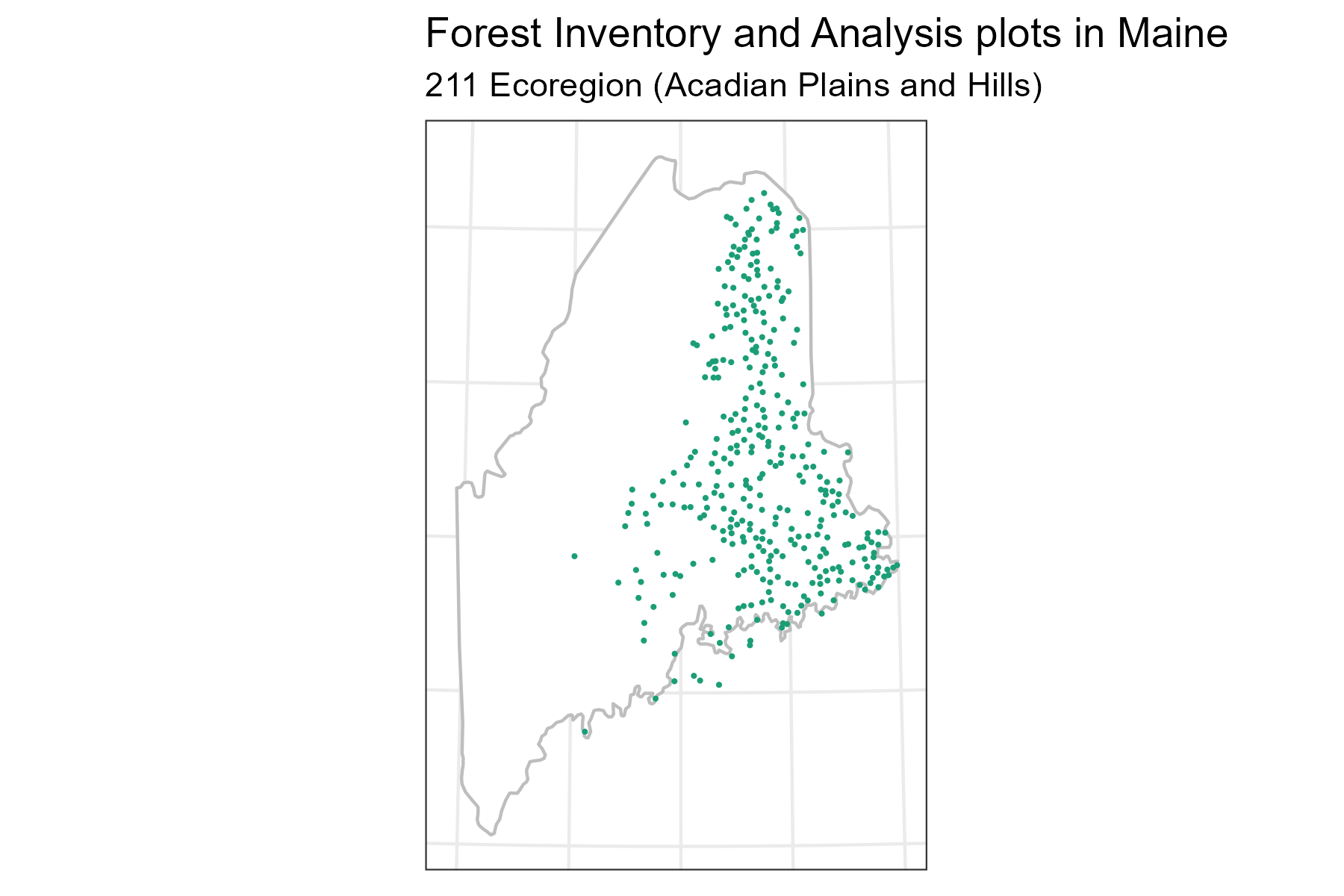
All FIA plots were queried from the state of Maine to create an example tree list to use in FVS. These plots were further queried to select all single-condition plots on timberland in the spruce-fir forest type group found in the Acadian Plains and Hills ecoregion (ecoregion 211). In total, 332 plots with 18,869 tree observations were selected.
New input variables in FVS
To implement the new NSVB equations in FVS, additional variables should be specified. For the StandInit and PlotInit tables, the following variables are used in some equations or lookup tables in the NSVB framework:
- ECOREGION: The ecological subsection code. Have a look at the map here for your ecoregion’s code. In the Maine data, this is ECOREGION = 211 for the Acadian Plains and Hills.
- STATE: The numeric state FIPS code for your project area.
- STDORGCD: A binary variable representing the stand origin code, i.e., whether the stand was established through planting or natural regeneration.
Actually, in the case of the Maine data, adding the STDORGCD variable likely doesn’t add anything. For a few species in the NSVB models, different equations are fit to the same species depending on whether they’re planted or natural regeneration. As far as I can tell, these separate equations only exist for loblolly pine and slash pine (at least in the eastern US).
For the TreeInit table, the following variables are can be input to obtain NSVB estimates of volume, biomass, and carbon:
- CULL: The percent cull of the tree, i..e., the total volume rotten or missing.
- DECAYCD: For standing dead trees, the decay class of the tree. This is a numeric value 1 through 5 representing the decay stage of the tree.
- WDLND_STEMS: If the observation is a woodland species, the number of stems.
These tree-level values are similar to to the FIA definitions which can be found in the FIA Database User Guide.
New output tables
The new volume, biomass, and carbon estimates can be found in three output tables after an FVS run:
- FVS_FIAVBC_Summary contains the summary of volume, biomass, and carbon values on a per acre level.
- FVS_FIAVBC_TreeList contains the tree list of volume, biomass, and carbon values for each individual tree.
- FVS_FIAVBC_CutList contains the list of cut trees and their volume, biomass, and carbon values.
Forest carbon simulations
The Maine FIA data were run through the FVS-Northeast variant and no management was specified. Three different estimates of aboveground live forest carbon were extracted. These carbon estimates included:
- The default equations provided in the Fire and Fuels Extension (FFE),
- The equations from Jenkins et al. 2003 (some of the most popular ones in forest carbon project development), and
- The new NSVB equations.
Calculating carbon with the Jenkins equations can be done by using the CarbCalc keyword. Both FFE and Jenkins estimates of carbon are reported in the FVS_Carbon table. The FIAVBC keyword can be specified to use the NSVB calculations.
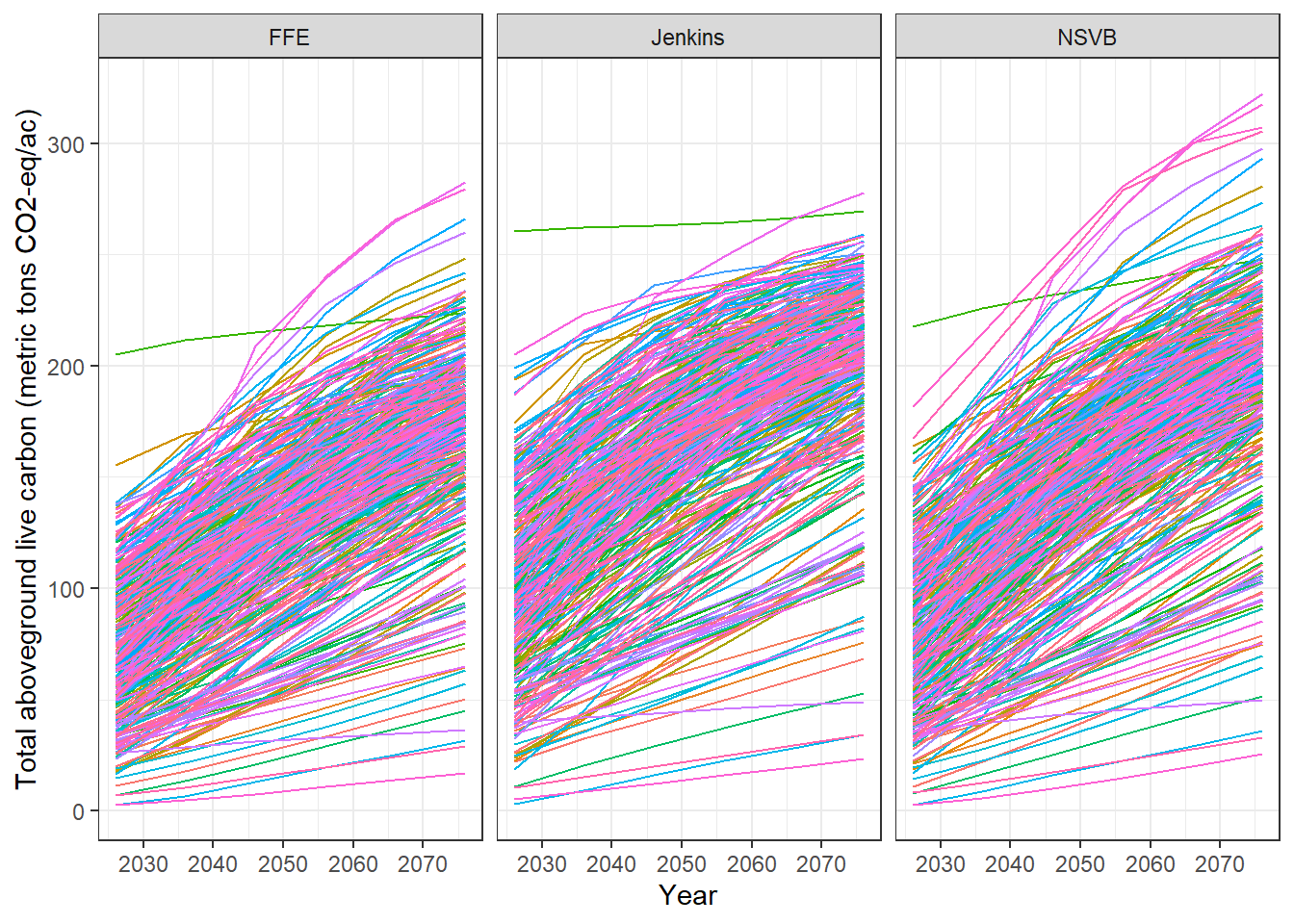
In a simulation of 50 years, here are the three different forest carbon prediction methods for each of the 300+ spruce-fir plots:
You’ll note that NSVB predictions have a few plots that predict much greater carbon compared to the FFE and Jenkins methods. The average growth rate seemed a bit high for this region of the state, with 2.1 mt C02-eq/ac/yr or about 0.7 cords/ac/yr. (This was a non-calibrated FVS run, and FVS growth seems to always run high in the region.)
When averaged across all plots, Jenkins equations provided the greatest carbon storage, followed by NSVB, and then FFE. The difference between Jenkins and NSVB estimates was as high as 17% in 2026 (at the start of the simulation) and as low as 4% in 2076 (the end of the 50-year simulation). The decreasing difference in these two estimates as stands age requires more digging, but likely has something to do with tree height not being used in the Jenkins equations.
There are no estimates available in FVS to predict tree carbon using the Component Ratio Method (CRM), another popular modeling framework that was previously implemented by the FIA program. However, I did a “quick and dirty” approximation of this by assuming NSVB estimates would be 8.9% greater than CRM estimates, using an analysis that summarized NSVB and CRM differences within the state of Maine.
Here are the average values across the 300+ plots for each estimation method:
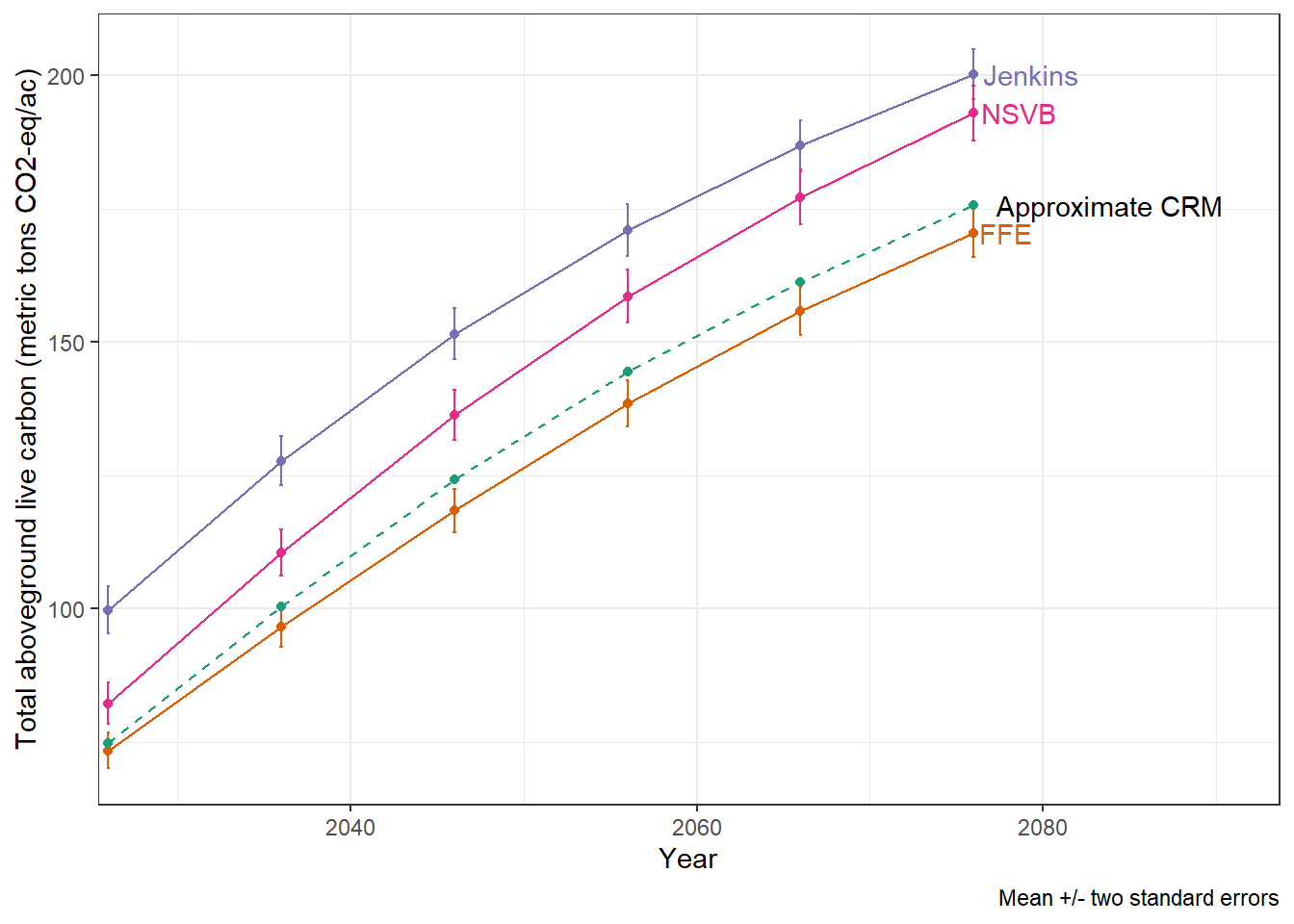
Here you can see how important the selection and use of the equations are in determining forest carbon stocks. No doubt these differences would change depending on data from your region and forest type.
Here are a few initial thoughts on the new NSVB equations as implemented in FVS:
- Summary table makes it easy to compare. It has always been difficult to obtain different estimates of forest carbon, as one would need to output the tree list and predict values independently, usually outside of FVS. Having the NSVB estimates in a separate table allows one to compare to other estimates like Jenkins. This is wicked convenient.
- It’s carbon, so pay attention to units. By default, the biomass and carbon units in the FVS_FIAVBC_Summary table are in US short tons per acre. I don’t see a way to change the default units in this table–a bummer for me, because I am addicted to changing the units to metric tons per acre using the CarbCalc keyword to use the more common unit of measure in the forest carbon world.
- Carbon in standing dead trees is still a chore. The addition of decay class in the input tree list is great because carbon in standing dead trees can be quantified using the NSVB approach. But standing dead tree carbon is still messy in FVS. It seems standing dead tree carbon is provided in the FVS_FIAVBC_Summary table for the initial measurement year. But isn’t tracked through time and standing dead trees drop off the tree list. What I like about the FVS_Carbon table from FFE is the separation of live and standing dead trees in two separate columns. The FFE component of FVS contains submodels for handling standing dead trees, but I don’t think this can be connected to the NSVB tables. More exploration is needed here…
- Tree table has a lot of attributes The FVS_FIAVBC_TreeList table has several other values for components, such as foliage biomass and carbon and amount stored in merchantable portions and in sawtimber. There are handy for a number of applications.
- Check merchantability limits. Using the NSVB keywords triggers all merchantability limits to be set to the FIA definitions. For example, a 9.0-inch minimum diameter for softwoods and an 11.0-inch minimum diameter for hardwoods. Best to check these for your application.
Just some initial thoughts for now, and special thanks to the FVS Staff for incorporating these equations into the model. If anyone has any helpful tips and tricks, don’t hesitate to reach out!
–
By Matt Russell. Subscribe to our monthly email newsletter for data and analytics trends in the forest products industry.