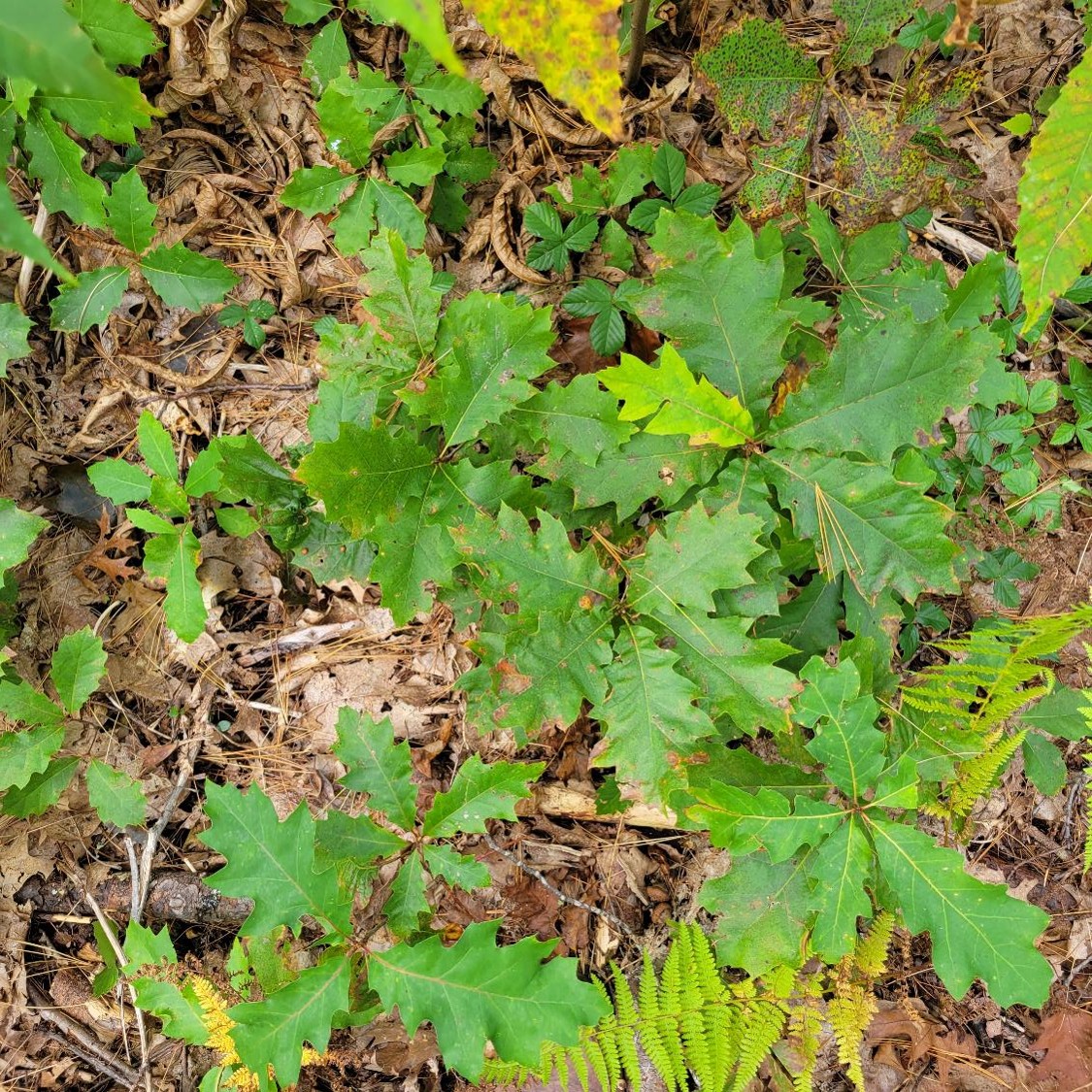
The Forest Vegetation Simulator is a widely used forest growth and yield model used in forest carbon project development. It has been in development for decades and can be applied to any geography in the United States, making it one of the most popular tools for simulating carbon dynamics. The FVS model is used by forest carbon project developers, researchers, and forest managers to simulate project scenarios and forest management treatments.
The FVS model is commonly used by supplying a list of trees collected through a forest inventory. Tree measurements such as species, diameter, and height and used to forecast what the trees will look like in 20, 50, or 100 years. A variety of stand metrics are then summarized from the projected individual tree records to provide useful metrics such as basal area, volume, and carbon.
A lesser used approach of FVS modeling is simulating a stand from bare ground, that is, with no existing tree list. This is equivalent to starting a stand from year 0 where a specified number of seedlings can be input as being planted or originating from natural regeneration. Adding regeneration, whether to form a new stand or add new trees to an existing stand, has a tremendous impact on long-term forest simulations.
This is an approach that is often done after simulating a harvest in a stand because many regional variants lack a “full” regeneration submodel. A full regeneration establishment model is available for some FVS variants in the western US. However, a “partial” establishment model is available for all other variants, where a user needs to manually add the number and species of regenerating trees to establish a new cohort. Many species will regenerate automatically in FVS if they have the ability to stump sprout (e.g., oaks and aspen), but for most species, regeneration needs to be added manually. Regeneration can be added with the NATURAL (seedlings regenerate naturally) or PLANT keywords (seedlings are planted).
Modeling a stand from bare ground also needs to be carried out in afforestation and reforestation projects. Entering the appropriate number of seedlings planted, their species, and survival rates prepares a stand for the future where management actions can be specified as the trees grow and mature.
This post explores modeling a stand from bare ground in FVS, with some pointers to consider when modeling.
Case study: Northern hardwood regeneration
As an example, assume a bare piece of ground suitable for a productive forest in the northeastern US. I simulated a northern hardwood forest to regenerate with the following species and number of seedlings:
- Sugar maple (400 seedlings per acre)
- Yellow birch (200 seedlings per acre)
- Eastern hemlock (200 seedlings per acre)
In FVS, I specified the NATURAL keyword to input these seedlings on three stands with site indices of 55, 65, and 75 feet at 50 years. For more of a how-to on implementing regeneration in the FVS web browser interface, see this post from a few years ago.
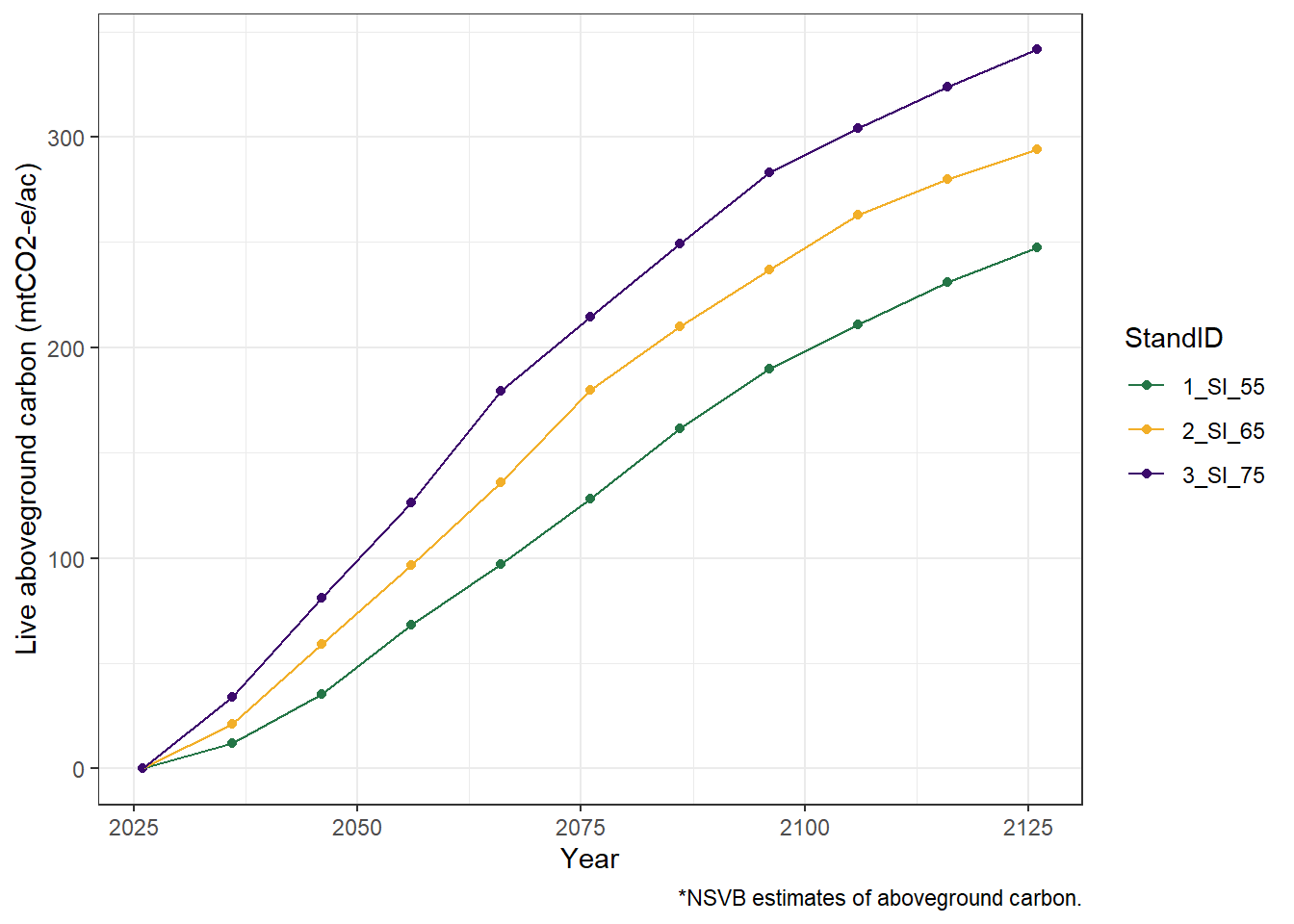
Using the Northeast variant of FVS, here is the total aboveground carbon simulated for 100 years after regenerating 800 seedlings per acre of the three species (using the NSVB equations available in FVS):
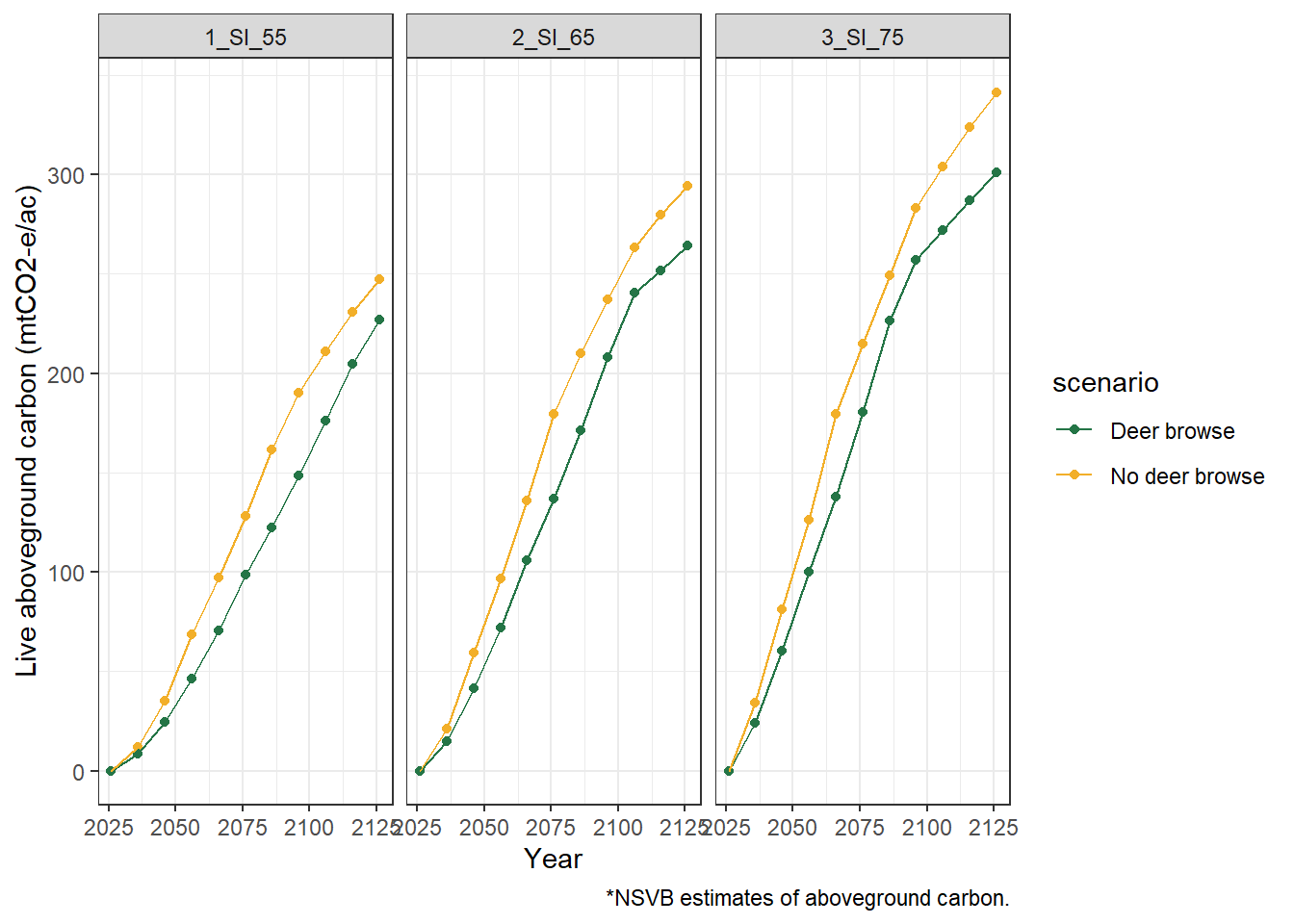
The NATURAL keyword, along with its sister, PLANT, allows for several additional parameters to be specified, including the percent survival of the seedlings and their average age and height at establishment. As an example, consider browse from white-tailed deer, a common forest health problem in northeastern US forests. The results below show a 25% survival of the sugar maple seedlings, assuming the majority of seedlings of this species are browsed by deer. Adding different survival percentages to the FVS keywords yields different forest structure through time:
Here you can see how important the selection and use of the equations are in determining forest carbon stocks. No doubt these differences would change depending on data from your region and forest type.
Here are a few user perspectives on running plots from bare ground in FVS:
- Regeneration first appears in the second growth cycle. If you add regeneration in 2026, you expect it to show up in 2026. However, FVS does not establish new seedlings into the tree list until the subsequent simulation cycle, so regeneration will be “lagged” when looking at your summary output. There are a few ways around this, and a simple workaround that I’ve used is to simply start the growth at one cycle prior (e.g., in 2016 instead of 2026). This means my 800 trees per acre show up in 2026.
- Sprouting can lead to an abundance of trees. Although many of the eastern FVS variants only have a partial establishment model, sprouting will occur for those species where it naturally occurs. This may not matter if you’re starting from bare ground with an empty tree list, but if you’re adding trees after a harvest, or if there are other species in the tree list that are sprouters, you will see regeneration for those species. You can turn sprouting off using the NATURAL or PLANT keywords.
- Survival percentage can be modified. Forest managers that plant seedlings often have a good idea of the survival rate they will expect, pending future weather and subsequent growing season conditions. The ability to modify the survival percentages with the PLANT keyword is a great parameter to dial in expectations of planting success.
- Pay attention to small tree growth equations. Most FVS variants have a separate set of submodels for small trees (e.g., trees less than 5.0-in DBH) and large trees. The growth of seedlings will be dependent on these small-tree submodels, so be aware of how they perform for species that you typically work with. As us modelers know, much more research and development has been done on merchantable trees, so small-tree growth equations may underperform relative to your expectations. There is a great summary in this US Forest Service report (Hoover et al. 2021) that discusses the importance of growth in the small-tree equations (see pages 7-8).
–
By Matt Russell. Subscribe to our monthly email newsletter for data and analytics trends in the forest products industry.