Carbon has quickly become a mechanism to address current and future climate challenges. As the largest terrestrial sink of carbon dioxide, forests are looked at as a natural climate solution.
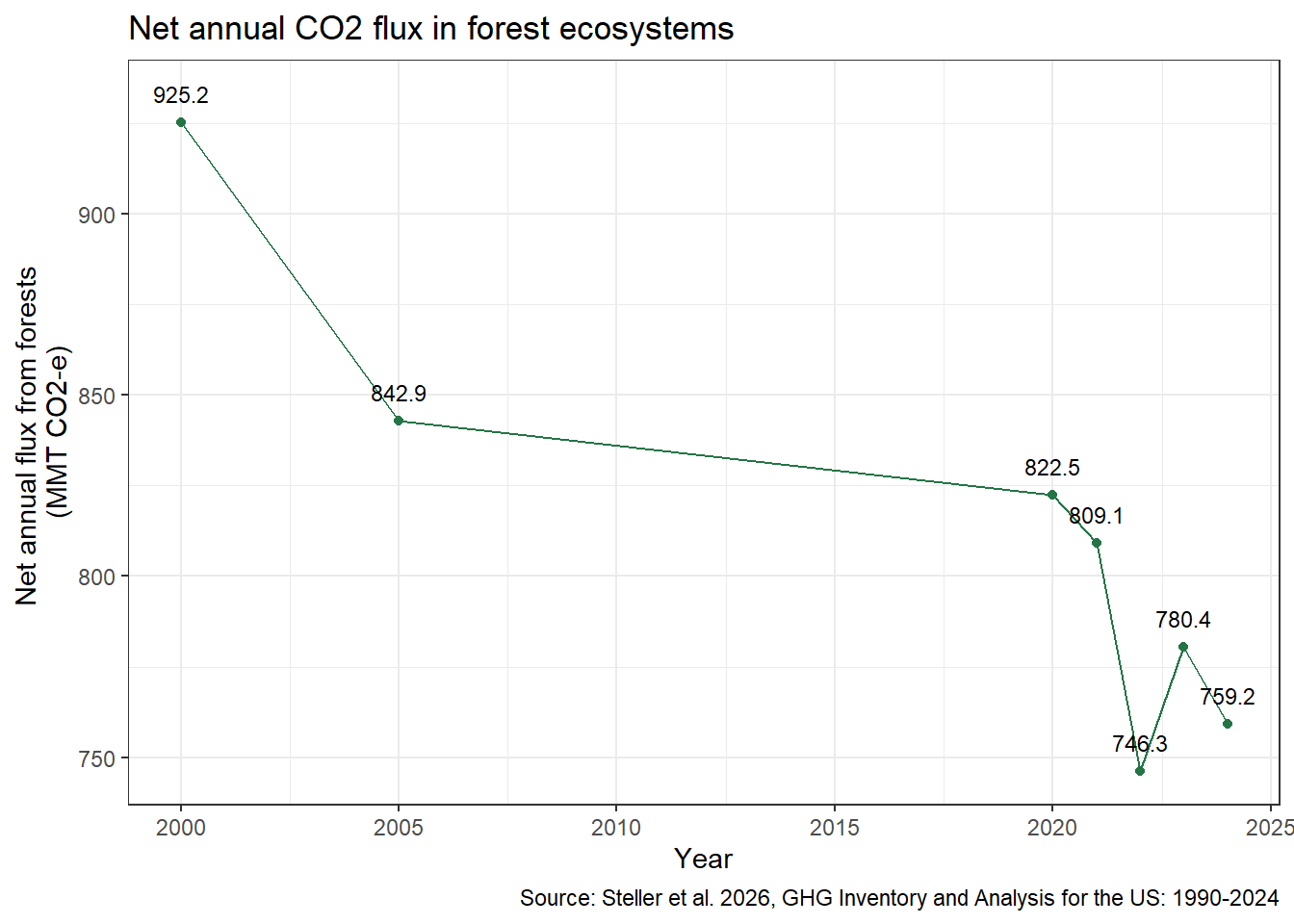
This is because forests sequester carbon dioxide from the atmosphere. Forests act as carbon sinks, and despite the numerous disturbances and forest health challenges affecting many ecosystems, US forests remove more carbon then they emit. According to the latest Greenhouse Gas Inventory report for the US, forests sequestered 759.2 million metric tons of CO2-equivalent in 2024.
Despite being the largest terrestrial sink of carbon, the “sink strength” of forests has declined over the last 25 years. In 2000, forests sequestered 925.2 million metric tons of CO2-equivalent:
This downward trend in the US’ sink strength is related to several issues. One reason researchers will always cite is that disturbances such as wildfire and insect and disease outbreaks have increased in frequency and severity during this century. This is certainly true, and analyzing Forest Inventory and Analysis data will support this.
But there are several human and market factors that have led to the US’ shrinking sink strength:
- Decrease in timber harvesting. The first quarter of this century has seen a global recession, a global health pandemic, and a shift in consumer preference for paper products. This led to the closure of several mills that consumed a large amount of raw wood products. Whether you believe it’s the chicken or the egg, this led to a decrease in timber harvesting. In states like Minnesota, the state harvested 2.65 million cords of wood in 2024, about one million cords less than the average annual harvest levels observed in the early 2000s. This decrease in harvesting feeds into the next two points.
- Forests are aging. Given the decrease in timber harvesting, forests are aging. Age is a tricky measurement in forestry, but look at any growth model form and you’ll note that older and bigger trees don’t grow as fast as younger trees. Any analysis of the sink strength of forests should also consider forest age.
- Forests are getting more dense. The total area of high density forest stands (as measured by stand relative density exceeding 0.60) has quintupled over the past 20 years. This increase in stand density subjects more trees and stands to forest disturbances and additional forest health threats.
So while forests continue to be a carbon sink, their sink capacity has declined over the last 25 years. A decline in the extent of timber harvests have resulted in many impacts to the forest products industry and how we think about forests in natural climate solutions. Active forest management can play a role in increasing the US’s carbon sink strength.
–
By Matt Russell. Subscribe to our monthly email newsletter for data and analytics trends in the forest products industry.